Guides · Buying
Buying a ruin or old farmhouse in Portugal: the legal checks before you pay
 By Carla Maria Marques, Portuguese solicitor (solicitadora)
November 2026 · 3 min read
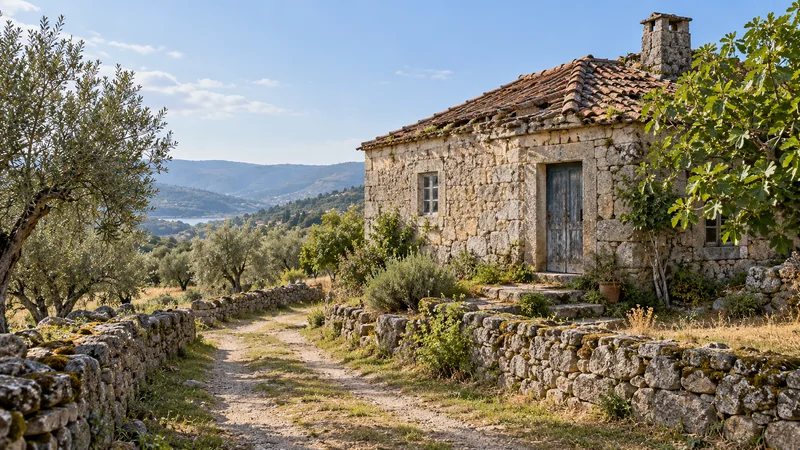
Four thick stone walls, no roof, a fig tree growing through the kitchen and a price that seems too good to be true. Restoring an old farmhouse is the dream that brings many buyers to rural Portugal.
Sometimes the price is low for a good reason. The biggest risk with a ruin is not the state of the walls: it is buying a building you are not allowed to rebuild, or rebuild in the way you imagined.
This guide covers the legal checks to make before you pay anything, so that the dream does not end at the planning office.
Does the building legally exist?
This is the first and most important question. A ruin you can see is not necessarily a building the law recognises.
Check how the building appears in the records:
- Is it recorded as an urban building in the tax record and the Land Registry, or does the plot appear only as rustic land, with no reference to a house?
- Does the description match what is on the ground: number of floors, footprint, outbuildings?
- Is there any licensing history, or is the building old enough to be exempt from the licences required for more recent constructions?
A tax or Land Registry entry is useful evidence of how a building has been recorded, but does not prove that it is lawful in planning terms or that reconstruction is permitted. Check the municipal history, the lawful pre-existing building and any later works separately.
Can it be rebuilt, and how?
A recorded ruin does not automatically carry a right to rebuild or extend it. The applicable control may be a licence, prior communication or a statutory exemption, depending on the work and special restrictions. The assessment includes:
- the municipal master plan (PDM) for that location;
- whether the land falls within the agricultural reserve (RAN) or the ecological reserve (REN);
- the size and footprint of the existing building, which often limits what can be rebuilt;
- other restrictions, such as protected areas, flood zones or heritage rules.
Ask the municipality before you buy
Portuguese law allows a request for prior information (pedido de informação prévia, or PIP) to be submitted to the municipality. Its usefulness and binding effect depend on what is requested, the decision, its conditions and the applicable period of validity. It should describe the project you actually intend to carry out.
For a ruin, a suitably scoped PIP, usually prepared with an architect, can reduce uncertainty. Where appropriate, make completion depend on an acceptable decision in the CPCV. A general indication about the plot is not a guarantee that every proposed design will be authorised.
The other checks
Also check the energy-certification position. Buildings legally qualifying as ruins have a specific exclusion, which must be supported by the appropriate official evidence; the seller’s description of a building as a ruin is not enough.
Buy the ruin, not the problem
At MGPS International we check old buildings and rural plots before our clients commit. Our team brings together a solicitor and a cadastral technician, so we look at the paperwork and at the land itself.
For a ruin, that means:
- confirming whether and how the building exists in the records;
- checking the plot’s classification, restrictions, access and boundaries;
- working alongside your architect on the request to the municipality, where needed;
- drafting a promissory contract that protects your deposit until the key answers are in;
- completing the purchase, registering it in your name and regularising what needs fixing.
Found a ruin you’d love to restore? Request a property check before you pay a deposit. Send us the location and the listing, and we’ll tell you what needs checking and quote a fixed fee.
This article is for general information only and is not legal advice for any specific case. Reconstruction depends on the applicable planning rules, lawful pre-existence and the control procedure required for the proposed works.
About the author
Carla Maria Marques
Portuguese solicitor (solicitadora), MGPS International