Guides · Buying
Buying rural land in Portugal: a step-by-step guide
 By André Filipe Soares, Trainee lawyer
November 2026 · 6 min read
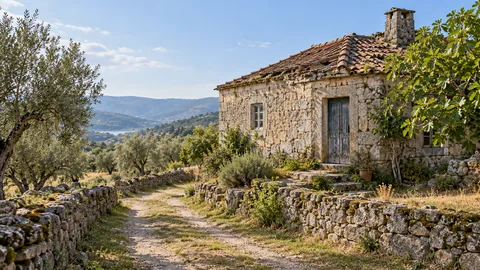
A hillside with olive trees, an old stone house, a view that stops you in your tracks. Rural Portugal is easy to fall in love with, and land can look remarkably affordable.
Rural property can raise issues that are difficult to spot on a viewing: areas that do not match the documents, unregistered plots, restrictions on building and legal rights of preference. These need checking before you commit.
This guide walks you through the purchase in the order it actually happens, and shows what to check at each step.
Step 1: Get your Portuguese tax number first
You cannot buy property in Portugal without a Portuguese tax number (NIF). Get it before you start making offers, so that you can move quickly when you find the right place.
If you live outside the EU or the relevant EEA countries and establish a Portuguese tax relationship, you may need to appoint a tax representative or join an accepted electronic notification service. There are exceptions, including rules for activities subject to VAT. A Portuguese bank account can be useful, but is not a universal legal requirement for buying property.
Step 2: Check the three records, not just one
In Portugal, information about a property lives in three separate places. They are run by different authorities, and on rural land they frequently disagree.
| Record | Where | What it tells you |
|---|---|---|
| Land Registry (Registo Predial) | Conservatória | The registered owner and registered mortgages, attachments and other charges; the entry must be checked with the title and any succession documents |
| Tax record (Matriz / Caderneta Predial) | Tax Office (Finanças) | How the property is classified, rustic or urban, and its tax value |
| Cadastre or BUPi | Directorate-General for the Territory / BUPi | The mapped location and configuration, subject to the legal status of the cadastral information or RGG |
Ask the seller, or their agent, for the current Land Registry certificate and the tax record before you commit to anything.
Warning signs:
- the seller’s name in the Land Registry is not the person selling, for example because the owner has died and the inheritance was never settled;
- the area in the deed is very different from the area you can see on the ground;
- the property exists in the tax record but not in the Land Registry;
- there is a mortgage, a lien or another charge that has not been cleared.
Each issue needs to be understood and addressed in the purchase terms. Some, such as cancellation of a mortgage, can be dealt with at completion under a clear arrangement rather than necessarily before a deposit is paid.
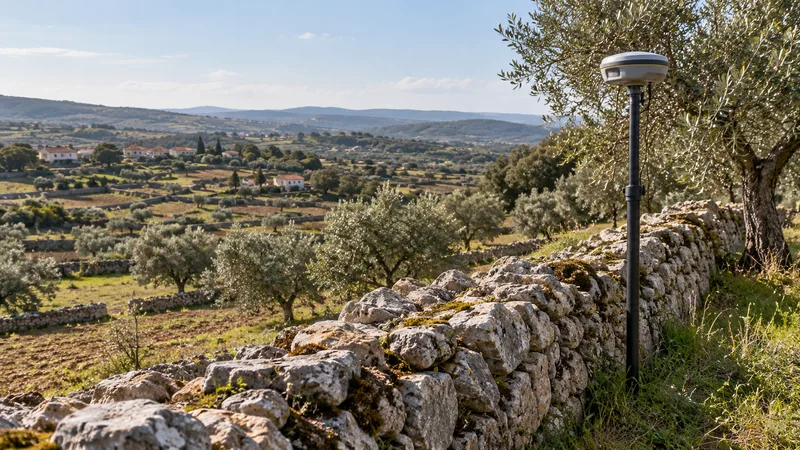
The BUPi outline (RGG). For plots within the system, check the identification required by Article 19 of Law 78/2017 as amended in 2026. It generally requires the RGG number in the transactions covered, with provisions for an official database check, plots already on the Cadastral Map and statutory exceptions. An RGG may carry a geometry reservation: the outline is not an absolute guarantee of ownership or undisputed boundaries.
Step 3: Find out what you can actually do with the land
Tax classification is not planning permission. A plot described as rustic in the tax record is not, for that reason alone, either buildable or unbuildable. Check the PDM and the restrictions applicable to the intended use, including the agricultural reserve (RAN), ecological reserve (REN) and any other relevant constraints. Seek a suitable municipal planning decision where necessary.
Access and easements. Check that the plot has legal access, not just a track that “everyone uses”. Check also whether others have rights over your land, such as a right of way, a water channel or a power line.
Neighbours may have the right to buy first. In Portugal, owners of adjoining rustic land can, in certain cases, have a legal right of preference when a small rustic plot is sold. Tenant farmers may have similar rights. If these rights are ignored, the sale can be challenged later. They must be checked and, where they apply, the neighbours must be formally notified.
Step 4: The promissory contract and the deposit
Most purchases start with a promissory contract (CPCV), in which buyer and seller commit to the sale and the buyer pays a deposit (sinal).
A deposit has legal consequences. Subject to the contract and the applicable law, definitive default attributable to the buyer can lead to loss of the deposit, while definitive default attributable to the seller can entitle the buyer to double the deposit. Delay, withdrawal and definitive default are not interchangeable; other remedies may also apply.
This is why the checks in steps 2 and 3 should be done before you sign the CPCV, not after. A well-drafted contract also sets out what happens if a problem with the property comes to light before completion, and gives a realistic deadline to solve it.
Step 5: Taxes, signing and registration
Purchase taxes. For an ordinary purchase of rustic land, the general IMT rate is 5%, and stamp duty is generally 0.8%, subject to the relevant valuation rules, exemptions and special regimes. The taxable value is usually the higher of the declared price and the tax value. Urban and mixed properties require a separate calculation.
Signing. The sale can be completed by public deed or an authenticated private document, including through the competent registry service. A solicitor or lawyer can prepare and authenticate a private document within their legal powers, subject to impediments; the same person cannot act as a party’s attorney and authenticate that act. The required electronic deposit and property identification must also be completed.
Registration. The acquisition must be registered within the applicable deadline. Registration protects the acquisition against third parties under the registry rules. Check the tax and cadastral updates separately; signing or registering the purchase does not automatically correct every discrepancy.
After you buy. You will pay the annual municipal property tax (IMI). Keep your address up to date with the Tax Office so that you receive notices on time.
How we help
Our service combines review of the legal records with the technical checks needed to compare the documents with the land and identify issues before you commit.
With MGPS International you get:
- A property check before you commit: a written report on the three records, charges, access, building restrictions and neighbours’ rights, in plain English.
- A tailored contract: terms dealing with the deposit, the checks still outstanding and the consequences of any material problem.
- Completion and registration: we can prepare and authenticate the purchase document ourselves and register the property in your name.
- Problems fixed: wrong areas, missing registrations and cadastre updates, before or after the purchase.
You don’t need to be in Portugal for any of this. We work by video call and email, and you can sign a power of attorney in your own country.
Found a property you like? Request a property check before you pay a deposit. Tell us where it is and what you know about it, and we’ll reply with what needs checking and a fixed fee.
This article is for general information only and is not legal advice for any specific case. Tax rates as of the date of publication.